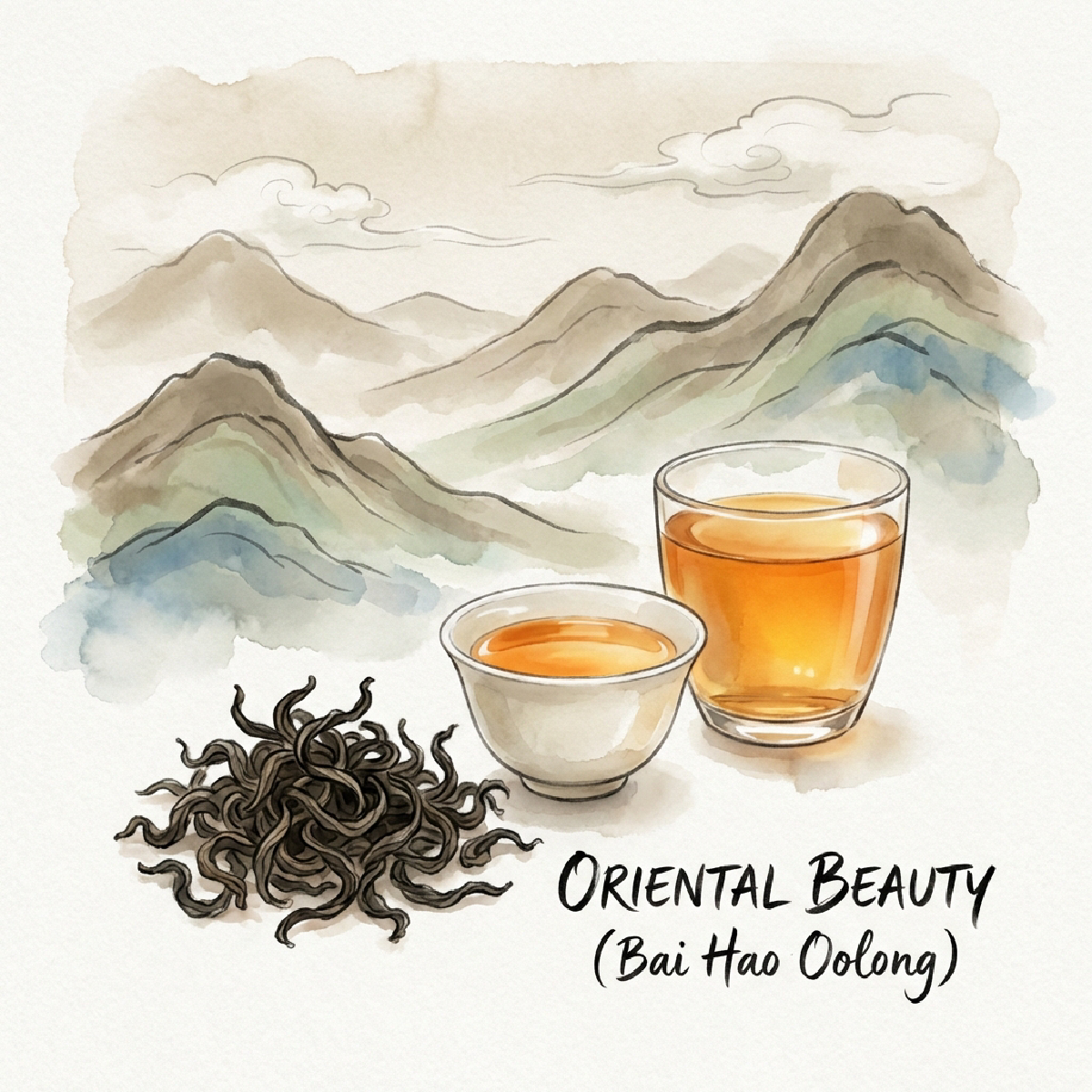
The History: The Tea Bitten by Insects
Oriental Beauty (Dongfang Meiren) is perhaps the most unique oolong in the world. Its story begins with a “mistake” in the late 19th century.
A farmer in Hsinchu, Taiwan, noticed that his tea crop had been heavily infested by tiny insects called Green Leafhoppers. Rather than throwing the crop away, he processed the bitten leaves. The result was a tea with a startlingly sweet, honey-like aroma. When he took it to a merchant, it sold for a record price. His neighbors didn’t believe him, calling it “Bragger’s Tea” (Peng Feng Cha).
The name “Oriental Beauty” was allegedly given by Queen Elizabeth II (some say Queen Victoria), who was so captivated by the tea’s colorful leaves “dancing” in her glass that she gave it this royal title.
Geography: The Summer Heat of Hsinchu
Unlike most premium teas that are harvested in the spring, Oriental Beauty is a summer tea, harvested in June and July when the Green Leafhopper population is at its peak.
- Terroir: The main production areas are Hsinchu and Miaoli in Taiwan. The environment must be strictly organic—if pesticides are used, the leafhoppers won’t bite the leaves, and the tea won’t develop its signature flavor.
- The Bite: When the insect bites the tea leaf, the plant releases a defense chemical that reacts with the air, starting a “pre-oxidation” process while the leaf is still on the bush. This is what creates the natural honey and ripe fruit flavors.
Decoding the Grades
Oriental Beauty is highly oxidized (60-80%), making it closer to a red tea than a green oolong.
1. The Color Palette
High-quality Oriental Beauty is also called “Five-Color Oolong” because the dried leaves should feature five distinct colors: white, green, yellow, red, and brown. The more white buds (Bai Hao) present, the higher the grade.
2. The Fragrance
- Special Grade: Intense honey, musk, and ripe peach.
- Standard Grade: Sweet, floral, and slightly woody.
How to Identify Quality
A true Oriental Beauty is defined by its natural, unforced sweetness.
| Feature | High-Quality (Premium) | Lower-Quality (Mass Market) |
|---|---|---|
| Appearance | Distinct “five colors” with many white downy buds. | Uniformly dark or brown; few or no white buds. |
| Aroma | Explosive natural honey, lychee, and rose. | Faintly sweet, woody, or stale. |
| Liquor | Clear, bright amber-orange; oily sheen. | Dull yellow or murky brown. |
| Taste | Sparkling sweetness (like honey water), smooth, and fruity. | Thin, astringent, or metallic. |
Reputable Brands & Where to Buy
Because it is entirely dependent on nature and insect activity, authentic Oriental Beauty is rare and expensive.
Reputable Specialized Brands:
- Hsinchu/Miaoli Farmers Associations: They hold annual competitions and provide certified, graded tins.
- International-Friendly Online Shops:
- Eco-Cha: Direct from the source in Taiwan, focusing on small-batch organic producers.
- Taiwan Sourcing: Offers a wide range of competition-grade and heirloom varieties.
- Floating Leaves: Excellent for high-end Taiwanese oolongs with deep educational context.
- The Tea Hong: Highly curated, premium selections of summer harvests.
Oriental Beauty is the “perfume” of the tea world. It is one of the few teas that should be brewed with slightly cooler water (80-85°C) to protect its delicate honeyed notes. It is a masterpiece of collaboration between nature, insects, and human skill.