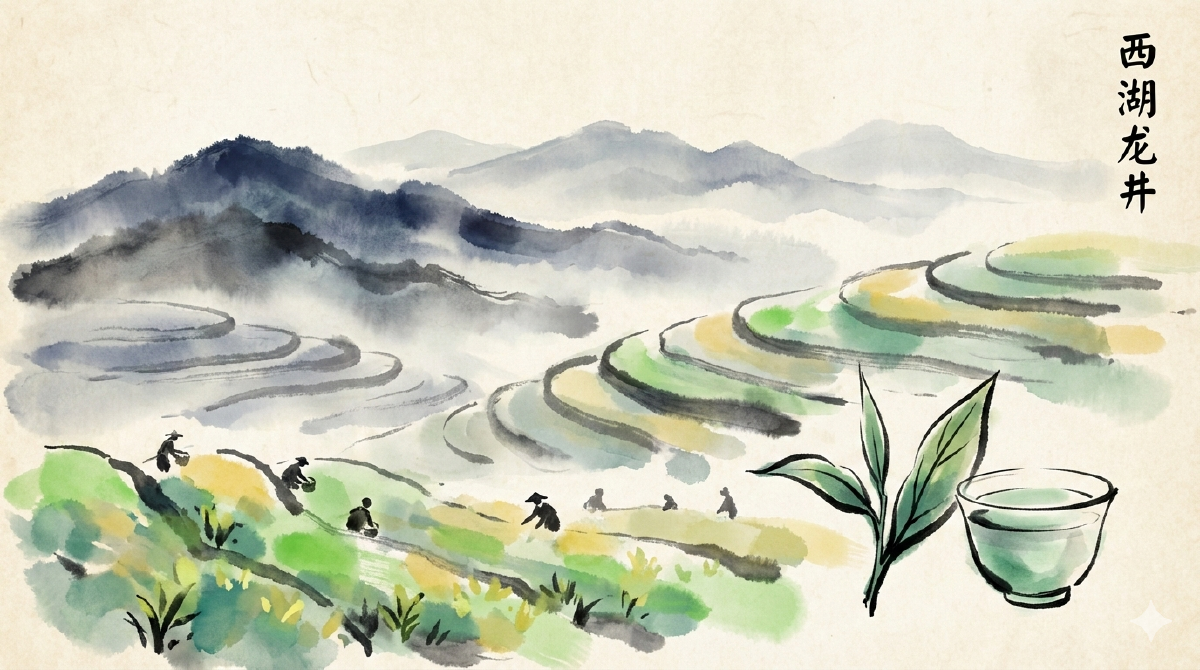
The Myth and History: Why “Dragon Well”?
Longjing’s history stretches back over 1,200 years to the Tang Dynasty, but it truly became a legend during the Qing Dynasty.
According to legend, the Emperor Qianlong visited West Lake and was so impressed by the tea at Shifeng (Lion Peak) Mountain that he granted “Imperial” status to 18 tea bushes. Some gardens still point to “imperial bushes” associated with this story.
The name itself comes from a village well that, according to local folklore, was home to a rain-bringing dragon. During a drought, a monk supposedly prayed at the well, and the dragon obliged by bringing rain to save the tea crops. When you brew the tea, the leaves dance in the water, sometimes resembling tiny dragons swirling in a well.
Geography: The “Terroir” of Hangzhou
The best Longjing comes from a very specific area around West Lake (Xihu) in Hangzhou. This region is a lush, misty basin with acidic, sandy soil—the perfect environment for tea.
The Five Core Micro-Regions
Authentic West Lake Longjing is further divided into five famous peaks/villages, each with its own “flavor profile”:
- Lion (Shi Feng): The most prestigious. Known for a yellowish-green color and a “high” aroma.
- Dragon (Longjing Village): The namesake of the tea.
- Cloud (Yunqi): Known for a refreshing, cooling taste.
- Tiger (Hupao): Named after the famous Tiger Spring (it is said that Tiger Spring water + Longjing tea is the perfect match).
- Plum (Meijiawu): The largest production area, known for its beautiful jade-green color.
Decoding the Grades
When shopping, you’ll see terms like “Pre-Qingming” or “Special Grade.” Here is how to navigate the jargon:
1. The Harvest Timing (The Most Important Factor)
- Ming Qian (Pre-Qingming): Picked before April 5th. These are the “champagne” of Longjing—extremely tender, sweet, and expensive because they are the first buds of spring.
- Yu Qian (Before the Rains): Picked between April 5th and April 20th. These have a bolder, more robust flavor and are much more affordable for daily drinking.
2. The Official Grading System
Longjing is officially graded into six levels:
- Special Grade (Te Ji): Pure buds and one tiny leaf; perfectly flat and uniform.
- Grades 1–5: As the grade number increases, the leaves get larger, the color gets darker/greener, and the flavor becomes more “grassy” rather than “nutty.”
How to Identify Quality
You don’t need to be a master to spot good tea! Use your senses:
| Feature | High-Quality (Premium) | Lower-Quality (Imitation) |
|---|---|---|
| Appearance | Flat, smooth, spear-shaped; yellowish-green (jade). | Curled, broken, or uneven; very dark green. |
| Aroma | Toasted chestnut, sweet bean, floral. | Grassy, fishy, or no scent at all. |
| Liquor | Clear, pale yellow-green. | Cloudy or brownish. |
| Taste | Sweet “Umami,” buttery, no bitterness. | Harsh, astringent, or bitter. |
Pro Tip: Look for the Geographical Indication (GI) sticker on the tin. Authentic West Lake Longjing often comes with a QR code or scratch-off serial number that can help verify it was produced within the protected Hangzhou zone.
Reputable Brands & Where to Buy
Finding authentic Longjing online can be tricky because it is the most faked tea in the world. Stick to specialized vendors who provide the harvest date and cultivar (Look for “Qunti” or “Longjing #43”).
Reputable Specialized Brands:
- West Lake Tea (Hangzhou local brands): Look for Gongpai (the official brand of the tea farmers’ association) or Shi Feng.
- International-Friendly Online Shops:
- Verdant Tea: Great for small-batch, farmer-direct transparency.
- Seven Cups: Excellent for high-end, authentic West Lake sourcing.
- Meimei Fine Teas: Highly curated selection with detailed harvest info.
- Teavivre: A solid, reliable option for different price points (from everyday to premium).
Longjing is more than just a drink; it’s a piece of Chinese history in your cup. For your first try, I recommend a Grade 1 Yu Qian—it offers the best balance of that classic nutty flavor and price.