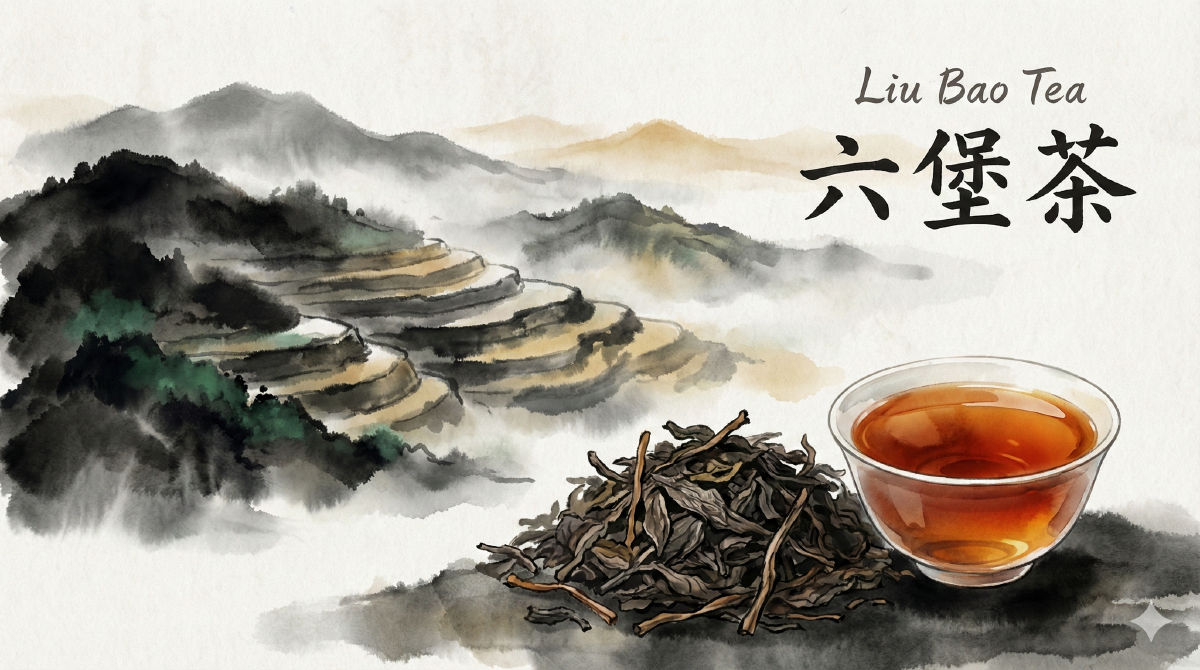
The History: The Ancestor of Ripe Pu-erh
Liu Bao tea is a historic “Hei Cha” (Dark Tea) from Guangxi Province with a history spanning over 1,500 years. During the late 19th and early 20th centuries, it was the “life-saving tea” for Chinese miners in Southeast Asia (Malaysia and Singapore) because of its cooling properties and its ability to settle the stomach in hot, humid climates.
Crucially, Liu Bao is the technological ancestor of Ripe (Shu) Pu-erh. The “Wet Piling” fermentation technique used to make Ripe Pu-erh in the 1970s was actually adapted from the traditional fermentation methods of Liu Bao. While Pu-erh is more famous today, Liu Bao remains the “soul” of dark tea for many traditional drinkers.
Geography: The Mists of Cangwu
The home of Liu Bao is Cangwu County in the city of Wuzhou, Guangxi.
- Terroir: The region is mountainous with red soil and high humidity. The tea is traditionally aged in large bamboo baskets in caves or specialized wooden warehouses.
- The Bamboo Basket: Unlike Pu-erh which is often pressed into cakes, Liu Bao is traditionally fermented and aged in massive bamboo baskets (some weighing over 40kg). The bamboo allows the tea to breathe and absorb a subtle woody aroma over decades.
Decoding the Grades & Characteristics
Liu Bao is prized for its “Four Perfections” (Si Jue): Red, Thick, Pure, and Aged.
1. Traditional vs. Modern
- Traditional (Handmade): Often lighter in fermentation, requiring many years of aging to become smooth. It has a more “lively” and complex profile.
- Modern (Factory): Uses the wet-piling process to make the tea smooth and drinkable within a few years.
2. The “Betel Nut” Aroma (Bing Lang Xiang)
The most sought-after characteristic of high-quality aged Liu Bao is a natural aroma of betel nut (a common palm nut in the region). It is a cooling, slightly woody, and nutty scent that is the hallmark of a masterfully aged batch.
How to Identify Quality
A good Liu Bao should be “clean” and “warming,” with no hint of mold or mustiness.
| Feature | High-Quality (Premium) | Lower-Quality (Mass Market) |
|---|---|---|
| Appearance | Dark, sturdy leaves; if aged, it may feature tiny “Golden Flowers” (Eurotium cristatum) fungus. | Dusty, broken leaves; visible white/green mold. |
| Aroma | Betel nut, aged wood, sweet dates, and damp earth (in a good way). | Fishy, sour, or like wet cardboard. |
| Liquor | Deep ruby red or “burgundy”; clear and luminous. | Murky, cloudy, or dull brown. |
| Taste | Silky, thick, sweet, and incredibly soothing for the stomach. | Thin, watery, or harshly acidic/bitter. |
Reputable Brands & Where to Buy
The Liu Bao market is dominated by a few major state-run factories, but artisanal “farmer-made” tea is gaining popularity.
Reputable Specialized Brands:
- Three Cranes (San He - 三鹤): The most prestigious factory brand for Liu Bao.
- China Tea (Zhong Cha - 中茶): A massive producer with a wide range of aged selections.
- International-Friendly Online Shops:
- Yunnan Sourcing: Offers a great selection of Three Cranes and artisanal Liu Bao.
- Chawangshop: A specialty shop based in Kunming with a deep focus on Hei Cha.
- Tea Hong: Highly curated, traditionally aged Liu Bao baskets.
- Exotic Teas: Known for sourcing unique, small-batch Guangxi dark teas.
Liu Bao is the “medicine” of the tea world. It is the perfect tea to drink after a heavy meal or on a humid day. For the best experience, use boiling water and a purple clay (Yixing) teapot to bring out its deep, woody soul.