The Heart of Pu-erh: The “Big Three” Producing Regions
To truly understand Pu-erh is to understand the land and the people of Yunnan. This tea isn’t just a beverage; it is a living history of the Silk Road’s southern cousin—the Ancient Tea-Horse Road (Chama Gudao). For over a thousand years, caravans laden with tea traveled from these mountains to Tibet, Southeast Asia, and the Imperial Palace in Beijing.
Yunnan’s tea geography is centered around the Lancang (Mekong) River. The “Big Three” regions—Xishuangbanna, Pu’er, and Lincang—each offer a window into a different era of tea history and a different expression of the tea tree’s spirit.
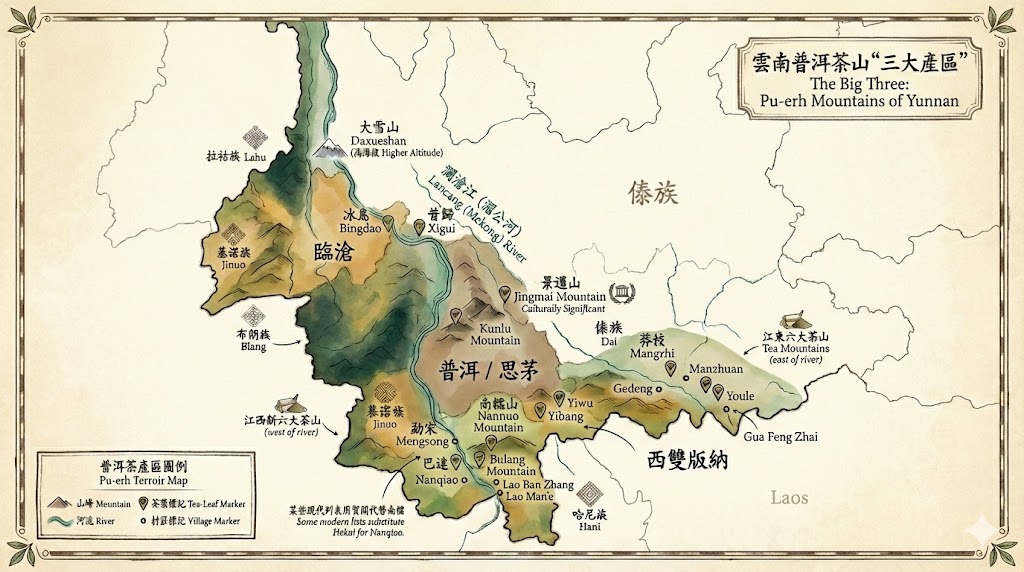
1. Xishuangbanna (西双版纳): The Imperial Legend
Xishuangbanna is the spiritual home of Pu-erh. Historically, it was the source of the most prized “Tribute Teas” for the Qing Dynasty emperors. The region is culturally dominated by the Dai people, though the high-altitude tea forests are often the ancestral domain of the Hani, Bulang, and Jinuo minorities.
The Six Famous Tea Mountains (East of the River)
Located in Mengla County, these mountains formed the core of the ancient tribute system.
- Yiwu (易武): The “Queen.” After a series of fires and social upheavals in the 18th century destroyed the original tea centers, Yiwu rose to prominence. It became the starting point of the Tea-Horse Road. The culture here is one of refinement; Yiwu tea is famous for its “gentle strength”—soft on the palate but with a powerful, lingering resonance.
- Taste Profile: Characterized by a “water-like” softness and high sweetness. It features elegant honey and floral aromas, a silky body, and a subtle but deep Huigan (aftertaste) that builds over multiple infusions.
- Notable micro-area — Gua Feng Zhai (刮风寨): Deep in the Yiwu forest near the Laos border. The name means “Windy Village.” Historically isolated, its trees grew wild and undisturbed, resulting in a tea with a “wild” forest character that connoisseurs crave today.
- Taste Profile: Extremely thick and heavy-bodied. It possesses a distinct “wild” forest fragrance, notes of dark honey, and a powerful, cooling sensation in the throat (Hou Yun).
- Yibang (倚邦): Historically a major commercial and tribute-tea center known for producing small-leaf varietal teas (xiao ye zhong) and for its refined, aromatic profile compared to the more “powerful” mountains.
- Taste Profile: Elegant and high-aroma with a gentle structure—floral, herbal, and incense-like notes; sweetness builds gradually with a clean, lingering finish.
- Mangzhi (莽枝): A forested mountain traditionally valued for balance—less overtly “kingly” than some neighbors, but prized for harmony and drinkability over many infusions.
- Taste Profile: Medium body with a calm, steady bitterness that resolves into sweetness; often shows soft wood, wildflower, and light citrus peel notes.
- Manzhuan (蛮砖): Once a key production zone along the trade routes; modern Manzhuan teas are often sought for their “old mountain” character and deeper sweetness.
- Taste Profile: Round, mellow bitterness with a deeper, dark-honey sweetness; forest and dried-fruit tones with a warming, grounded aftertaste.
- Gedeng (革登): The smallest (and historically among the least accessible) of the six, with teas that can feel compact, resinous, and quietly powerful when sourced from older trees.
- Taste Profile: Tighter structure with a resin/wood-spice edge; sweetness emerges late and persists, often with a cooling throat feel.
- Youle (攸乐): The only one of the Six Mountains inhabited by the Jinuo people. It was historically the first of the mountains mentioned in imperial records.
- Taste Profile: Bright and lively with a refreshing bitterness that clears quickly. It offers a clean, fruity sweetness (reminiscent of stone fruits) and a high-toned, grassy aroma.
The New Six Famous Tea Mountains (West of the River)
Located west of the Lancang River, these are the mountains most often cited in modern “New Six Famous Tea Mountains” lists.
- Nannuo Mountain (南糯山): Known as the “King of Cultivated Tea Trees.” In the 1950s, a 800-year-old cultivated tea tree was discovered here, proving that the Hani people had been systematically farming tea for centuries, contradicting the colonial belief that tea was only “found” in the wild.
- Taste Profile: Exceptionally balanced and approachable. It has a moderate body, light bitterness, and a distinct “high-mountain” honey sweetness. It is often described as having a “rounded” mouthfeel.
- Bulang Mountain (布朗山): The heartland of the Bulang people and the archetype of “strength” in modern Pu-erh. Bulang’s fame is inseparable from its villages—some of which have become global shorthand for power and bitterness.
- Taste Profile: Big structure and assertive bitterness with strong Cha Qi. The finish often turns strongly sweet with a persistent, cooling throat feel.
- Notable village — Lao Ban Zhang (老班章): The “King.” The history of Ban Zhang is one of transformation; once a poor, remote outpost, it is now the most famous name in Pu-erh. The Bulang people have a saying: “Without bitterness, there is no tea.” Lao Ban Zhang embodies this—an intense, commanding bitterness that transforms into a sweetness so profound it feels like a physical sensation.
- Taste Profile: Renowned for its explosive Cha Qi (energy). It has a bold, heavy bitterness that melts instantly into a massive, sugary Huigan. The aroma is often described as “wild orchid” or smoky-sweet.
- Notable village — Lao Man’e (老曼峨): Often cited as among the oldest Bulang villages in the area. It is known for ancient Buddhist temples and for producing an incredibly bitter, medicinal tea that represents the true, unadulterated soul of Bulang Mountain.
- Taste Profile: Famous for its “soul-crushing” bitterness. However, for those who appreciate it, the bitterness is “clean” (not astringent) and gives way to a deep, resonant sweetness. It has a thick, syrupy texture and a long-lasting cooling effect.
- Jingmai Mountain (景迈山): Famous for ancient tea forests tended for over a millennium by Blang and Dai communities. Jingmai is prized for fragrance more than brute force.
- Taste Profile: High floral/orchid fragrance, light-to-medium body, low bitterness, and a clear, “cool” aromatic finish.
- Mengsong (勐宋): A highland area in Menghai often valued for clarity and “mountain air” character—teas that can feel brisk, clean, and well-structured without being overwhelmingly aggressive.
- Taste Profile: Bright bitterness that resolves quickly, crisp sweetness, and a fresh, herbal/green-wood aromatic line.
- Bada (巴达山): A storied region associated with older tree resources and a classic, straightforward Menghai profile—firm, reliable structure with a clean transition into sweetness.
- Taste Profile: Medium-to-strong bitterness and astringency up front with a solid body; sweetness emerges steadily with a clean, drying minerality.
- Nanqiao (南桥 / 南峤): Often listed as one of the “new six” in modern writing. In practice, this refers to the Menghai/Nanqiao area and its surrounding tea-growing zones rather than a single, discrete “mountain” in the older tribute-era sense.
- Taste Profile: Commonly described as a classic Menghai profile: firm structure with a clean, quickly returning sweetness; tends toward a straightforward, satisfying bitterness-sweetness arc.
Note: “New Six Famous Tea Mountains” is a modern, market-driven label, and some contemporary lists substitute Hekai (贺开) for Nanqiao (南桥/南峤) depending on author and era.
2. Pu’er / Simao (普洱/思茅): The Gateway to the World
The city of Pu’er (formerly Simao) was the historical processing and tax collection center. While Xishuangbanna grew the tea, Pu’er sold it to the world.
- Jingmai Mountain (景迈山): A UNESCO World Heritage site. This is one of the most culturally significant tea landscapes in the region. For over 1,300 years, the Blang and Dai people have lived in a symbiotic relationship with the tea forest. Unlike the modern “plantation” style, Jingmai tea grows in a “natural tea garden”—a forest where tea trees grow under the shade of ancient banyans. The tea is famous for its “Orchid Fragrance” (Lan Xiang), which some attribute to the surrounding forest ecology (including epiphytes like Crab’s Claw).
- Taste Profile: Dominant floral/orchid aroma. The tea is light-bodied with almost no bitterness, featuring a sharp, piercing fragrance and a “cool” feeling in the mouth. It is prized for its elegance and fragrance over body.
- Kunlu Mountain (困鹿山): The “Forbidden Garden.” During the Qing Dynasty, Kunlu was a private imperial tea plantation. Soldiers guarded the mountain, and the finest “small-leaf” varietal tea was harvested exclusively for the Emperor. Commoners were forbidden from picking or even drinking it. This history of “seclusion” has left Kunlu with a unique, elegant, and highly sophisticated flavor profile that feels regal compared to the “wilder” teas of Lincang.
- Taste Profile: Extremely delicate and refined. It has a complex, “noble” sweetness and a silky mouthfeel. The aroma is high-toned and multi-layered, with hints of rare herbs and wildflowers.
3. Lincang (临沧): The Wild Frontier
To the north lies Lincang, home to some of Yunnan’s oldest and most storied tea tree regions. Ages are often reported in the centuries—and sometimes far more, depending on the specific tree and source. Lincang teas are often defined by their “wildness” and high-altitude intensity.
- Bingdao (冰岛): The “Iceland” of Yunnan. A village of the Lahu and Dai people. Historically, Bingdao was a “seed base”—its seeds were so prized that they were transported across Yunnan to start other plantations. Today, Bingdao is the “white gold” of Pu-erh, known for its incredible “Rock Sugar” sweetness. The culture here is now one of extreme luxury, as a single kilogram of ancient tree tea from this village can cost thousands of dollars.
- Taste Profile: Legendary for its pure “Rock Sugar” sweetness (Bingtang Tian). It has almost zero bitterness, a thick syrupy body, and a powerful, persistent cooling sensation in the throat.
- Xigui (昔归): Located on the banks of the Lancang River at a surprisingly low altitude for such high-quality tea. The unique microclimate—hot days and misty nights by the river—creates a tea with a “masculine” profile. Xigui is often called the “Lao Ban Zhang of Lincang” because of its intense Cha Qi and commanding presence.
- Taste Profile: Powerful and bold with a distinct “savory” or “mushroom” undertone. It has a heavy front-palate impact, high energy, and a thick, oily texture that coats the mouth.
- Daxueshan (大雪山): The “Big Snow Mountain.” This is the home of the world’s highest-altitude ancient tea tree community. These trees grow in the wild, surrounded by snow for part of the year. The tea reflects this—clean, cold, and incredibly brisk, with a “high-mountain” fragrance that feels like breathing in the alpine air.
- Taste Profile: Brisk, fresh, and high-toned. It features “wild” forest notes, a slight resinous tang, and a very “clean” and sharp sweetness. It has a lighter body but intense aromatic complexity.
Cultural Significance: The People of the Trees
The history of Pu-erh is inseparable from the ethnic minorities of Yunnan.
- The Bulang: Believe they are the descendants of the “Tea Ancestor.” They say: “Gold and silver will run out, but tea trees will provide for our children forever.”
- The Hani: Famous for their terrace farming and their deep knowledge of tea tree health.
- The Dai: Historically the rulers and traders who facilitated the movement of tea from the mountains to the river ports.