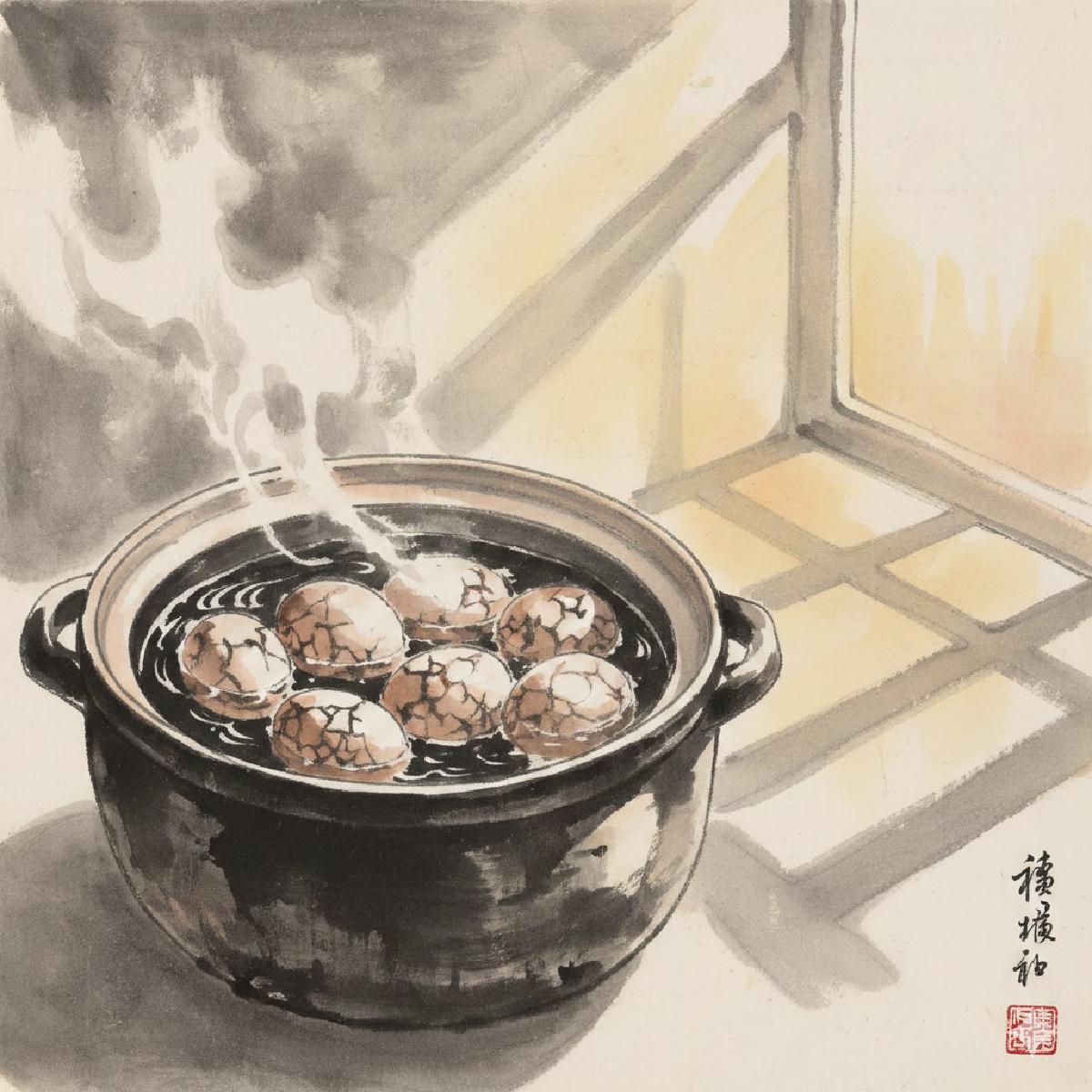
A Little Culture: Where Tea Eggs Come From
Tea eggs (茶叶蛋, cháyèdàn) are a everyday Chinese and Taiwanese snack: hard-boiled eggs simmered in tea, soy sauce, and spices until the shells are cracked and the whites are stained with a marbled pattern. They didn’t start in palaces or ceremonies—they came from home kitchens and street stalls. People used leftover tea leaves and a few pantry staples to add flavor and stretch ingredients. Today you’ll find them in convenience stores (like 7-Eleven in Taiwan), at breakfast stalls, and in night markets—cheap, portable, and deeply part of daily life. Making tea eggs at home is a simple way to bring that tradition into your own kitchen. Below are two recipes: a classic family-style version and a modern twist.
Traditional Family-Style Tea Eggs
This is the kind of recipe many families make: straightforward, forgiving, and great for using leftover black tea. The eggs improve if left in the broth overnight.
Makes: 6–8 tea eggs
Time: ~15 min active, 1–2 hours simmering (or overnight soak)
Ingredients
- 6–8 large eggs, at room temperature
- 2 tablespoons loose black tea (e.g. Keemun, Dianhong, or any black tea—leftover leaves from a session work well)
- 3 tablespoons light soy sauce
- 1 tablespoon dark soy sauce (for color; optional but recommended)
- 1 teaspoon salt
- 1–2 tablespoons rock sugar or plain sugar (to taste)
- 2–3 star anise
- 1 small cinnamon stick (about 2 inches)
- 3–4 cups water (enough to cover the eggs)
Optional: a few Sichuan peppercorns, 1–2 dried tangerine peel pieces, or a pinch of five-spice powder.
Steps
Hard-boil the eggs. Put the eggs in a pot, cover with cold water by about 1 inch, and bring to a boil. Lower the heat and simmer for 8–10 minutes. Drain and rinse under cool water until easy to handle.
Crack the shells (don’t peel). Using the back of a spoon or the handle of a knife, tap each egg gently all over so the shell is covered with fine cracks. This lets the tea and soy sauce seep in and creates the classic marbled look.
Make the tea broth. In the same pot (or a pot that fits the eggs in one layer), add the water, tea, light and dark soy sauce, salt, sugar, star anise, and cinnamon. Add any optional spices. Bring to a boil, then simmer uncovered for 5–10 minutes so the tea and spices infuse.
Simmer the eggs. Put the cracked eggs into the broth. They should be mostly covered; add a bit more water if needed. Simmer gently, partially covered, for 1–2 hours. Turn the eggs occasionally so they color evenly. For deeper flavor and color, turn off the heat and leave the eggs in the broth for several hours or overnight in the fridge.
Serve. Peel at the table or ahead of time. Eat warm or at room temperature. The broth can be strained and reused for another batch; store in the fridge and use within a few days.
Tips: Older eggs peel more cleanly. If the broth tastes too strong or salty, dilute with a little water. Adjust soy sauce and sugar to your taste—this recipe is meant to be flexible, like a family recipe.
Modern Twist: Smoky Lapsang Souchong Tea Eggs
Same idea as the traditional version, but Lapsang Souchong (正山小种) adds a clear smoky note. Great as a snack or sliced on rice, in congee, or in a salad.
Makes: 6 tea eggs
Time: ~15 min active, 1–2 hours simmering (or overnight soak)
Ingredients
- 6 large eggs, at room temperature
- 2 tablespoons Lapsang Souchong loose tea (smoky black tea)
- 2 tablespoons light soy sauce
- 1 tablespoon dark soy sauce (optional, for color)
- 1 teaspoon salt
- 1 tablespoon sugar or honey
- 2 star anise
- 1 small cinnamon stick
- 3–4 cups water
Optional: a strip of orange or tangerine peel, or a small piece of ginger (sliced) for a little brightness against the smoke.
Steps
Hard-boil and crack the eggs as in the traditional recipe: boil 8–10 minutes, cool, then tap the shells all over with a spoon so they’re finely cracked.
Brew the smoky broth. In a pot, bring the water to a boil and add the Lapsang Souchong. Simmer 3–5 minutes, then add soy sauces, salt, sugar, star anise, cinnamon, and any optional peel or ginger. Simmer another 5 minutes.
Simmer the eggs. Add the cracked eggs and simmer gently, partially covered, for 1–2 hours, turning occasionally. For stronger flavor, leave the eggs in the broth off the heat for a few hours or overnight in the fridge.
Serve. Peel and serve warm or at room temperature. The smoke pairs well with rice, congee, or a simple green salad.
Tip: If the smoke is too strong, use half Lapsang Souchong and half plain black tea.
One Culture, Many Ways to Cook
Whether you make the traditional family-style version or the Lapsang twist, you’re using tea the same way many home cooks have for generations: as a practical, flavorful ingredient. Tea eggs are a small bridge between tea in the cup and tea on the table—worth trying once you have a little black tea and a few spices on hand.